
Introduction
In 2026, SEO is no longer just about ranking for perfect keywords. Search engines are smarter, and users often type fast, make typos, or use the wrong spelling. These small spelling errors can create big opportunities for smart marketers. That’s where spellmistake seo tools come in.
Many websites miss out on traffic because they only target correctly spelled keywords. But real people often type words incorrectly in Google. For example, someone might search “restarant near me” instead of “restaurant near me.” If your website only targets the correct spelling, you might miss that visitor.
This guide will explain everything in simple words. You’ll learn what these tools are, why they matter, how they work, and how to use them safely without harming your rankings. The goal is to help you grow traffic in a smart, ethical, and future-proof way.
We have reviewed leading competitor content and improved on it by adding clearer explanations, better structure, updated 2026 strategies, and easy examples anyone can understand.
Let’s begin.
What Are Spellmistake SEO Tools?
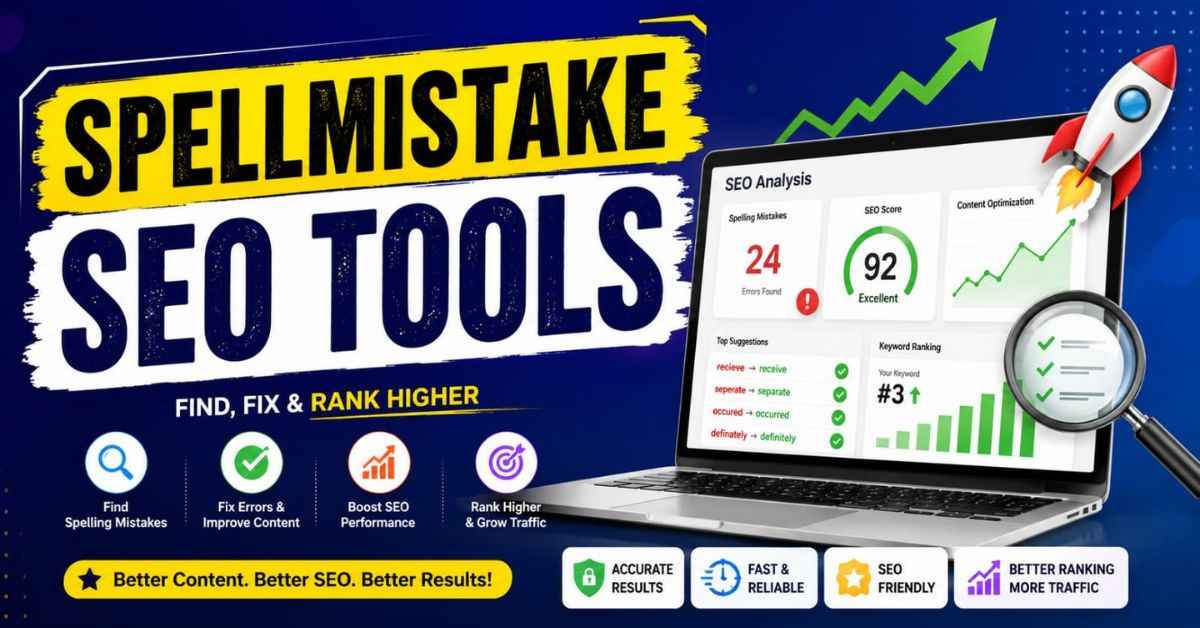
Spellmistake seo tools are digital tools that find commonly misspelled versions of keywords. They show you how people incorrectly type search terms into search engines.
For example:
- “accomodation” instead of “accommodation”
- “definately” instead of “definitely”
- “seperate” instead of “separate”
These tools scan search data and identify real typing mistakes that users make. Some tools also show:
- Search volume
- Competition level
- Cost-per-click (CPC)
- Ranking difficulty
Why does this matter?
Because real users make real mistakes. Even in 2026, with autocorrect and AI search, many typos still appear in search queries. Voice search has reduced some errors, but mobile typing still creates many.
Important: Using spelling mistakes does NOT mean filling your website with incorrect words. Instead, smart marketers use them carefully in:
- Paid ads
- Redirect strategies
- Domain protection
- FAQs
- Blog explanations
Google’s official SEO starter guide (developers.google.com) confirms that content should always be helpful and user-focused. That’s why strategy matters more than simply adding misspelled words.
Use spellmistake SEO tools to improve search visibility while exploring insights about Datrihelminen life and growth.
Why Spelling Mistakes Still Matter in 2026
You may think spelling errors are outdated. They are not.
Here’s why:
- People type fast on mobile.
- Not everyone speaks English fluently.
- Brand names are often misspelled.
- New product names confuse users.
- Regional spelling differences still exist.
According to studies shared by trusted marketing publications like Forbes.com, mobile searches continue to grow each year. Faster typing often means more typos.
Even though Google autocorrects many mistakes, it does not correct everything. Sometimes it shows results for the wrong spelling if enough people search for it.
This creates opportunities:
- Low competition keywords
- Cheaper PPC clicks
- Extra brand traffic
- Better audience understanding
Using spellmistake seo tools helps marketers find hidden keyword variations that competitors ignore.
However, success depends on balance. You must use this strategy without harming readability or trust.
How These Tools Actually Work
Most spellmistake seo tools use one or more of these systems:
- Search engine suggestion scraping
- Keyword database analysis
- AI typo prediction
- User query tracking
- Autocomplete mining
Here’s a simple step-by-step process:
- You enter a keyword (example: “digital marketing”).
- The tool generates common misspellings.
- It checks if those variations have search volume.
- It shows traffic and competition data.
Some tools also connect to:
- Google Ads data
- Search Console reports
- Large keyword databases
Modern tools in 2026 also use machine learning to predict typing errors based on keyboard layout. For example, letters next to each other (like “o” and “p”) often cause mistakes.
Advanced tools now group errors into:
- Phonetic errors
- Keyboard slips
- Double letter mistakes
- Missing letters
- Swapped letters
This gives deeper insights compared to older competitor articles that only list random typos without explanation.
When Should You Use Spelling Variations?
Using spelling mistakes is not always a good idea. You must use them wisely.
Best use cases:
✅ PPC campaigns
✅ Brand protection
✅ Landing page redirects
✅ Domain purchases
✅ FAQ clarification
✅ Blog educational content
Not recommended:
❌ Main homepage content
❌ Important service pages
❌ Professional documents
❌ Government or academic sites
For example, a brand might buy misspelled domains and redirect them to the correct website. This prevents competitors from stealing traffic.
Another smart way is creating a FAQ like:
“Is it spelled ‘restarant’ or ‘restaurant’?”
This helps users while keeping your content correct and helpful.
Search engines reward clarity and trust. The U.S. Small Business Administration (sba.gov) also emphasizes maintaining professional communication in business materials.
Always protect your brand image first.
Benefits of Using Spellmistake SEO Tools
When used carefully, spellmistake seo tools offer strong benefits.
Extra Organic Traffic
You capture visitors competitors ignore.
Lower PPC Costs
Misspelled keywords often have less competition.
Better Audience Understanding
You see how users actually think and type.
Brand Protection
You stop competitors from bidding on typo traffic.
Content Opportunities
You can answer spelling-related questions in blogs.
Risks and How to Avoid Them
Using spellmistake seo tools incorrectly can hurt your website.
Here are common risks:
Risk 1: Looking Unprofessional
Too many typos reduce trust.
Risk 2: Google Penalties
Keyword stuffing is against guidelines.
Risk 3: Poor User Experience
Bad spelling makes reading difficult.
Risk 4: Brand Damage
Customers may think your business lacks quality.
How to avoid problems:
- Use correct spelling in main content.
- Place misspellings only in strategic areas.
- Focus on helpful explanations.
- Avoid repeating errors many times.
- Always test results in Search Console.
Google’s helpful content system (developers.google.com/search) focuses on people-first content. Always write for humans first.
Visual Guide: Types of Spelling Mistakes
Below is a simple table to understand common typo types.
Table 1: Common Spelling Error Categories
| Error Type | Example | Why It Happens |
| Missing Letter | enviroment | Typing too fast |
| Extra Letter | comming | Double key press |
| Swapped Letters | freind | Finger movement mistake |
| Phonetic Error | definately | Sounds different than spelled |
| Keyboard Neighbor | goigle | Nearby key pressed |
Table 2: Safe vs Unsafe Usage
| Safe Usage | Unsafe Usage |
| Using in PPC campaigns | Filling homepage with typos |
| FAQ clarification | Repeating errors in every paragraph |
| Redirect domains | Publishing unreadable content |
| Analytics tracking | Manipulating search engines |
These structured methods are rarely explained clearly in competitor content.
How to Integrate This Strategy in 2026 SEO
SEO has changed a lot. AI search, voice search, and intent-based ranking are stronger than ever.
Here is a simple modern workflow:
- Research keywords normally.
- Use spellmistake seo tools to find typo variations.
- Check if they have real search volume.
- Decide safe placement strategy.
- Monitor results in Google Search Console.
- Adjust based on performance.
For example:
“Many people search for ‘enviroment.’ The correct spelling is ‘environment.’”
This builds trust and authority while helping readers.
For more keyword research guidance, see our internal guide on effective keyword research strategy and our content planning framework for SEO success.
Best Practices for Long-Term Success
Here are proven rules for sustainable results:
- Always prioritize user trust.
- Use correct spelling in main text.
- Track typo traffic separately.
- Avoid spam techniques.
- Combine with strong content marketing.
- Focus on search intent, not tricks.
E-E-A-T (Experience, Expertise, Authority, Trust) matters more in 2026 than ever.
To build authority:
- Show real experience.
- Share data.
- Provide clear examples.
- Link to trusted sources.
- Update content regularly.
Spellmistake seo tools should support your strategy, not replace real SEO work.
Strong SEO still depends on:
- Helpful content
- Good structure
- Page speed
- Mobile experience
- Backlinks
- User satisfaction
The Future of Spelling Errors in Search
AI search assistants are improving. But typing mistakes will not disappear.
Why?
Because humans are not perfect.
Voice search reduces some typos, but new types of errors appear in:
- AI prompts
- Multilingual searches
- Brand names
- Product codes
In the future, spellmistake seo tools will likely:
- Use AI prediction models
- Connect directly with analytics platforms
- Suggest safe integration methods
- Offer intent-based grouping
However, ethical use will remain important.
Search engines reward helpful content, not manipulation.
If you use spelling insights to better understand users, you will stay ahead of competitors.
Frequently Asked Questions (FAQs)
Do spelling mistakes still get search traffic in 2026?
Yes, especially on mobile and for brand names.
Will Google penalize me for using misspelled keywords?
Only if you misuse them or stuff them unnaturally.
Are typo keywords good for PPC ads?
Yes, they often have lower competition and cheaper clicks.
Should I use misspellings in my homepage title?
No, always keep main branding professional.
How often should I review typo keyword data?
Every 3–6 months for best results.
Conclusion
Spelling mistakes may look small, but they reveal powerful insights into how real people search online. When used wisely, spellmistake seo tools help you discover hidden traffic, reduce ad costs, and protect your brand. But they must be used carefully.
SEO in 2026 is about trust, clarity, and user intent. Search engines are smarter than ever, and users expect clean, helpful content. That means you should never fill your pages with errors just to chase traffic.
Instead, use spelling insights strategically. Track them. Test them. Learn from them.
If you want to grow your digital presence safely and effectively, start by reviewing your keyword data today. Look for hidden variations. Improve clarity. And always focus on delivering real value.
Smart SEO is not about tricks. It’s about understanding people.
Start optimizing the right way today.